
Quick insights
- System restart is the process of safely re-energising and restoring the power system affected by a major supply disruption or system black event.
- While these events are rare, the national electricity market (NEM) has an established system restart regulatory framework designed to support the Australian Energy Market Operator (AEMO), network service providers and generators providing system restart ancillary services (SRAS) to prepare for, and coordinate during, a major supply disruption.
- Restart testing is designed to validate whether a planned sequence of network equipment and generation units used to restore the power system, known as a restart pathway, operates as expected during an event.
- In October 2025, AusNet and AEMO identified and proposed changes to establish a more extensive testing framework for system restart (including mandating deep network testing in prescribed scenarios). The changes proposed would improve confidence in current restart pathways as the power system rapidly transitions.
- The Australian Energy Market Commission (AEMC) Reliability Panel adopted these recommendations in full as part of its Review of the System Restart Standard Final Determination released in December 2025.
- These reforms represent a major step forward in operational resilience of the power system during high-impact low probability events – bringing testing requirements in line with international best practice to deliver benefits to all electricity users.
- We are committed to working with industry partners to establish a framework for deep network testing within the National Electricity Rules (NER, Rules).
- As Victoria’s energy system transforms, AusNet will also continue to apply operational experiences from our Transmission Operations Centre (TOC) to solve emerging operational planning challenges in the NEM.
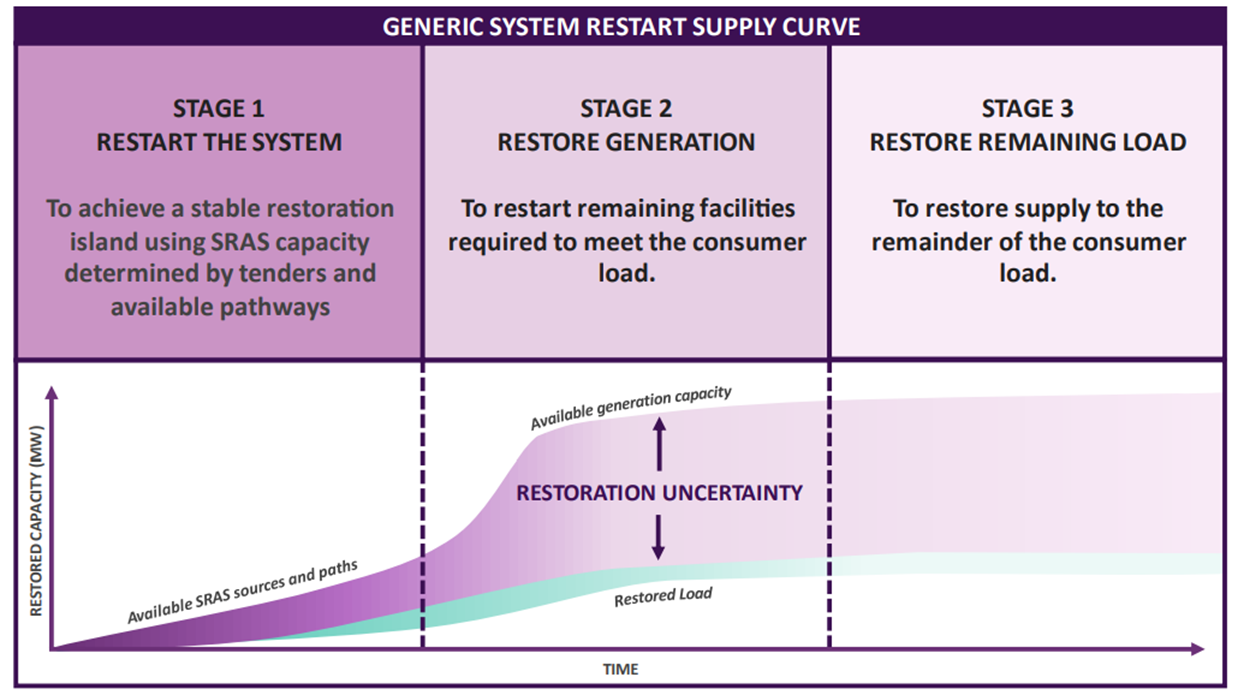
System restart, also known as “black start”, is the process of re‑energising the power system after a major supply disruption or system black event. The restart process has three conceptual stages:
- restart by achieving stable restoration islands
- re-energise remaining transmission facilities
- restore supply to the remaining consumer load (see diagram below).
Figure 1: System restart stages as defined by AEMO1
While these events are rare, system restart capability remains fundamental to power system security. The preparedness activities undertaken are critical to minimising the risk, duration and impact of major supply disruptions for electricity consumers.
Within the NEM, AEMO holds primary responsibility for system restart planning and emergency management. This includes procuring adequate SRAS from specialist generating units, developing system restart plans and coordinating the restoration of supply with market participants.
AEMO does not perform this role alone. In Victoria, we own and operates the majority of the transmission network with over 6,500 kms of our transmission lines serving a population of over 7 million Victorians. AusNet’s TOC acts as AEMO’s single point of contact during emergencies, including system black events. AEMO relies on AusNet to restore the Victorian network and maintain supply in these situations, avoiding the need for additional third-party interfaces. AEMO also requires technical information on our network asset capabilities and field resource availability to commence its restart plan for Victoria and jointly conducts system restart tests with TOC together and SRAS providers.
Our Transmission Operations Centre
The TOC monitors and controls the majority of the Victorian transmission electricity network to make sure it operates safely and securely.
It is responsible for:
- Monitoring, controlling and evaluating our transmission network. This includes assessing emerging issues and determining appropriate action. Our alarms notify us about the health and status of key network assets.
- Facilitating access to the network which requires close relationships with AEMO, connected generators and load.
- Developing and maintaining operational procedures for safe and secure operation of our network and providing technical advice on matters connected to the NEM and system security.
- Managing the transmission incentive schemes – we are incentivised to plan outages to minimise the impact on the electricity market.
Our TOC works closely with AEMO National Operations to keep the Victorian power system secure during normal operating conditions, planned outages, incidents and emergencies.
“System Restart is one of the most complex and high-stakes activities in power system operations. Our controllers and operational planners continue to work closely with AEMO Operations to improve Victoria’s restart readiness and address emerging risks.”
Martin Cavanagh, General Manager Security & Network Operations
One area of system restart of increasing importance in the NEM, and internationally, is the physical restoration testing framework.
What is restoration testing?
Restoration testing – commonly referred to as network or restart testing - refers to the real-world process of using a SRAS provider to re-energise parts of the transmission network and/or generation. The process is designed to validate whether a designed system restart pathway (i.e. a planned sequence of network equipment and generating units used to restore the power system) operates as expected during a major supply disruption.
What happens during the restoration testing process?
The NEM’s SRAS framework gives AEMO the authority to conduct a range of system restart tests (e.g. start-up, network energisation, synchronisation of generating units) depending on the SRAS service and restoration pathway.2 It also requires relevant network service providers and SRAS providers (i.e. test participants) to assist AEMO in the execution of these responsibilities (e.g. coordinate switching, provide technical support, configure the network for testing, start units independently).
The process typically involves:
- Determine whether a test is required.
- Consulting SRAS providers to agree on the purpose and scope of the test.
- Designing a detailed test program.
- Securing formal approval for the test to proceed under defined conditions.
- Executing the test.
- Reporting on performance and remediation of identified issues.
For further information please read AEMO’s 2021 System Restart Ancillary Services Guideline.
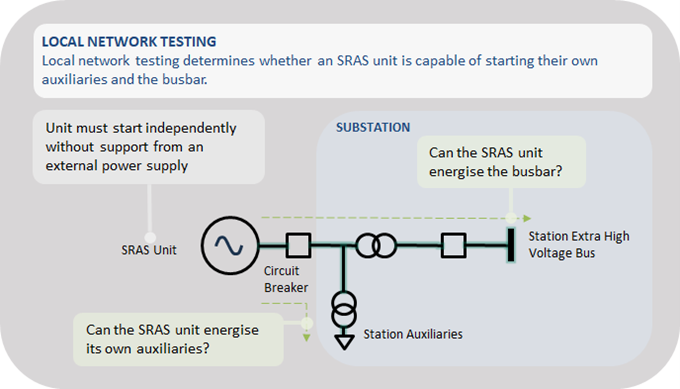
Restoration testing typically falls into two categories: local network testing and deep network testing. Local (or shallow) network testing is limited to assessing an SRAS providers’ capability to re-energise a busbar at a relevant black start site.
Source: AusNet
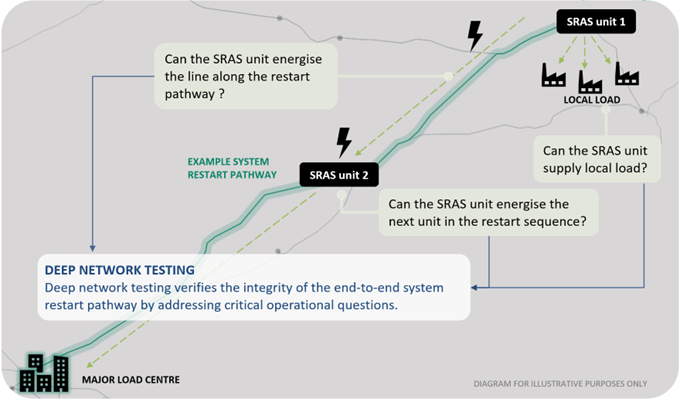
By comparison, deep network testing is more comprehensive in nature – assessing an SRAS providers’ capability to re-energise the restart pathway without disturbing customer load.
Source: AusNet
Deep network testing replicates the complexities of real-world conditions – validating modelling results, identifying how systems and assets interact in practice and which interfaces may require adjustment. Without testing under realistic conditions there remains a degree of uncertainty around how restart assets and systems will perform when called upon. In jurisdictions where deep network testing is conducted frequently, such as Texas, USA, issues are frequently identified and tests often require multiple attempts to succeed, even in pathways that had previously passed.3
Current NEM practice allows but does not require AEMO and relevant test participants to conduct extensive physical restoration testing on restart pathways.4 While this may have been appropriate in the past – the retirement of coal generators, proliferation of inverter-based resources and changing network configurations during the energy transition mean pathways that were previously effective at restoration may no longer be. In some cases, new restart pathways are required to reflect the new energy system.
Our view is supported and shared by AEMO. It has called for a dedicated ongoing deep network testing program for new and existing pathways and rule amendments to allow tests to confirm the feasibility of potential restart pathways (rather than only those already within a restart plan).5 An International System Restoration Review commissioned by AEMO and its global counterparts similarly recommended an expansion of physical testing – prioritising energisation trials beyond the busbar.6
We have been considering what could be done to support more extensive physical restoration testing in the NEM. In October 2025, our submission to the AEMC Reliability Panel’s Review of the System Restart Standard Draft Determination recommended three changes to modernise deep network testing requirements:
1. Clear definitions of local and deep network testing:
The definitions proposed in our submission (and below) are intended to clarify the scope of testing expected to be conducted. We recognise this is not formally defined in the current rules framework.
Local network testing definition
A basic startup test where SRAS units must be capable of operating in a stable manner supplying their own auxiliaries or running at zero export load for 30 minutes.
Deep network testing definition
A comprehensive test that involves at least one of the below tests as agreed between AEMO and the relevant TNSP(s):
- Line energising test:
- A test to verify the SRAS unit’s ability to energise lines along the cranking path.
- The SRAS unit must demonstrate the ability to energise enough transmission to deliver its output to required loads as specified in the System Restart Plan.
- Load7 carrying test:
- A test to verify the SRAS unit’s ability to supply a pre‑arranged load.
- The SRAS unit must demonstrate the ability to supply the required load while maintaining voltage and frequency for at least 30 minutes.
- Next‑start resource test:
- A test to verify the SRAS unit’s ability to start the next unit in the restoration sequence.
- The SRAS unit must demonstrate the ability to start the next SRAS unit’s largest required motor while maintaining voltage and frequency stability for at least 30 minutes.
2. Prescribed scenarios where deep network testing is required:
While the current rules framework provides flexibility for deep network testing to occur, this flexibility has not translated into consistent practice – with deep network testing rarely pursued.
This is because the decision to undertake deep network testing is a judgement call requiring all test participants to accept the risks of:
- undertaking the test, such as potential damage to transformers, operational complexity, cost implications
- foregoing the test, such as increased risk of restart failure due to unvalidated pathways, reduced confidence in restoration modelling, limited ability to identify and resolve latent issues in restart pathways.
When deep testing is required, defining reasonable scenarios removes the ambiguity of this call and allows all parties to commit to comprehensive testing when the risks and benefits are appropriately balanced.
Our submission recommends deep network testing to occur when:
- A new restart pathway is established or proposed
- A material change occurs to a SRAS unit
(e.g. rotor rewind, modifications to generator governor) - More than 10 years have elapsed since the last deep network test in the region
Our current view is that these prescribed scenarios offer enough flexibility to cover the different types of deep network testing required, balance the impact and costs of testing and align with international best practice.
3. Mandatory requirements for real‑time visible high‑speed monitoring:
Installing real-time monitoring equipment prior to a deep network test enables this activity to yield meaningful insights and supports test participants to accurately validate system behaviour against models. These devices provide 30-120 samples per second which allows for detection of fast acting power system phenomena, such as resonance oscillations or transient instability. Existing guidelines only require NSPs to use high-speed monitoring for testing on a ‘reasonable endeavours’ basis.
AEMC Reliability Panel’s Review of the System Restart Standard
The Review of the System Restart Standard was initiated to enhance system restart preparedness as the power system transforms. The review examined the broader SRAS regulatory framework and made recommendations on the appropriateness of the framework in the context of the future power system envisaged in AEMO’s Integrated System Plan. It also determined a revised system restart standard to reflect current conditions and provide flexibility for AEMO to procure black start and restoration support services.
In December 2025, the AEMC Reliability Panel’s Review of the System Restart Final Determination adopted recommendations put forward by us, AEMO and other stakeholders. This included the following recommendations:
- AEMO undertakes future-focused restoration modelling and reports on system restart needs in the 2026 Transition Plan for System Security (TPSS).
- The AEMC further considers whether other stakeholders should be involved in future focused restoration planning – including TNSPs and DNSPs.
- The Reliability Panel drafts a Rule Change Request strengthening system restart testing arrangements.
We are pleased to see the Reliability Panel’s recommendation on system restart testing aligns with our recommended changes. Its Final Determination found our proposal “a constructive basis upon which a potential framework for deeper network testing can be established within the Rules.”
“The Reliability Panel’s system restart recommendations are a major step forward for the operational resilience of the power system during high-impact low probability events. Once implemented, NEM transmission operators will have improved tools to validate and execute system restoration plans as the power system transitions.”
Jason Jina, Policy & Reform Manager
The Reliability Panel’s recommendations are a timely reminder that system restart must be underpinned by coordinated planning, physical validation and strategic investment – not just market procurement.
Looking ahead to 2026, we will work with the Reliability Panel, AEMO and industry partners to establish a deep network framework within the Rules that improves operational readiness. A Rule Change Request is due in the first half of this year.
We also continue to leverage the operational expertise of TOC to help solve emerging operational planning challenges faced in the NEM. We are one of the few, if not the only, TNSP in Australia and globally with decades of experience dealing with multi-operator risks.
We are increasingly seeing challenges associated with:
- multiple parties operating shared network assets within a single jurisdiction, which slows real-time incident response times and prevents utilisation of 3rd party assets during emergencies
- securing planned outages, which are increasingly at risk of system condition related cancellations that impact the timely delivery of network upgrades and generator connections.
Glossary
- Black System Event – Cascading tripping where sections of the system lose power or are islanded, or where there is an entire shutdown of the system.
- Busbar – A common electrical node or connection point where multiple circuits, lines, or equipment are electrically connected in a terminal station.
- Restoration Island – An electrically isolated portion of the power system containing energised load
and generation, from which the system may be restored. - Reliability Panel – Panel within the AEMC whose purpose is to monitor, review and report on the safety, security and reliability of the national electricity system. The Panel also determine standards and some of the guidelines used by AEMO and other market participants.
- System Restart Ancillary Services – One of two types of services provided by plant or facilities:
- Black Start Services capable of starting without drawing power from the power system following a major supply disruption, or
- Restoration Support Services (RSS) with the capabilities described in AEMO’s SRAS Guideline.
- System Restart Ancillary Services Provider – Specialised plant capable of starting without an external power source whom AEMO contracts with to provide SRAS at black start ready terminal stations.
- System Restart Standard – Technical parameters set by the Reliability Panel that AEMO must be consistent with when developing System Restart Plans and procuring System Restart Ancillary Services. This includes the:
- maximum time in which a specified level of generation capability must be restored in each sub-network
- aggregate level of reliability of restart services in each sub-network.
- System Restart Plan – Plan prepared by AEMO for managing and coordinating system restoration activities during any major supply disruption in a NEM region.
- System Restart Test – This is a physical test within an electrical sub-network to verify the potential to implement the applicable System Restart Plan.
Footnotes
1AEMO, System restart technical advice, June 2025. Accessed here.
2AEMO, SRAS Guidelines, January 2021. Accessed here.
3ISON, International System Restoration Review, August 2025. Accessed here.
4In its Draft Determination the Reliability Panel found that system restart testing obligations under clause 4.3.6(b) and clause 4.3.6(h) provided sufficient discretion for AEMO to establish testing procedures to test deeper into existing restart pathways, so long as this testing procedure is supported by impacted test participants.
5AEMC, Review of the System Restart Standard Final Report, December 2025. Accessed here.
6ISON, International System Restoration Review, August 2025. Accessed here.
7Load testing is expected to be conducted using batteries or industrial loads such as pumps. Testing using these loads provides both the TNSP and AEMO confidence in the System Restart Plan, without de-energising commercial or residential customers. Where industrial customers are involved, participation should be agreed in advance.