Australia is experiencing rapid growth in large-scale data centres, driven by cloud computing, artificial intelligence and the broader digital economy. Across Victoria and the National Electricity Market (NEM), this growth is increasingly visible as clusters of high-demand facilities seek to connect to the electricity network.
Our Integrating Data Centres paper supports a more informed, industry wide, coordinated approach to accommodating data centres within the Victorian electricity network.
As the owner and operator of Victoria’s transmission network, we are seeing a significant increase in both the scale and concentration of data centre connections around key terminal stations. This has prompted us to take a closer look at the challenges we face operating our network and keeping the system secure, as data centres become a greater proportion of Victoria’s overall system load.
Finding a pathway that safely integrates data centre load in the NEM matters because the upside is significant. Data centres play a central role in our everyday lives by driving economic growth, productivity and innovation. The digital economy is forecasted to drive A$1 trillion in data centre investment across Asia-Pacific by 20301. Data centres can also offer some benefits to the electricity system on a project specific basis – for example, underwriting renewable power purchase agreements.
This paper brings together what we know today. It draws on Australian and international evidence and the experience of our regulated transmission business and technical consultants, Bespoke Energy.
This paper does not provide comment on issues outside of data centre related power system integrity challenges – for example, accuracy of demand forecasts or cost allocation.
Why we are sharing this work
Our paper aims to share insights into data centre power system interactions and explore a coordinated pathway to their safe integration. This includes:
-
sharing insights into the technical components of data centres and how they interact with the power system
-
highlighting the most pressing power system risks associated with data centre integration in Victoria and across the NEM
-
sharing our views on areas for industry collaboration, including near term actions, to proactively integrate data centres.
The research shows that inverter-based data centres behave differently from the relatively passive large loads the power system was historically designed for. If left unmanaged, this behaviour can have an adverse power system impact beyond our existing operational controls.
Potential impacts include:
-
lower-than-expected fault ride through capability
-
rapid active power ramping leading to frequency control challenges
-
power quality issues
-
risk of forced oscillations.
This landscape introduces challenges similar to those first encountered when large-scale wind and solar generation were connected to the network. As the industry adapted then, there is a similar need now to recognise the distinct characteristics of data centres and reflect these in how we plan, connect and operate the power system. This includes developing representative and validated models of data centre behaviour, establishing consistent technical requirements and real-time monitoring.
We are encouraged by progress already made in the NEM to safely integrate data centres. With a coordinated and well-informed approach, our industry can address the most pressing power system risks and close process and information gaps across planning, connections and operations.
How are data centres different?
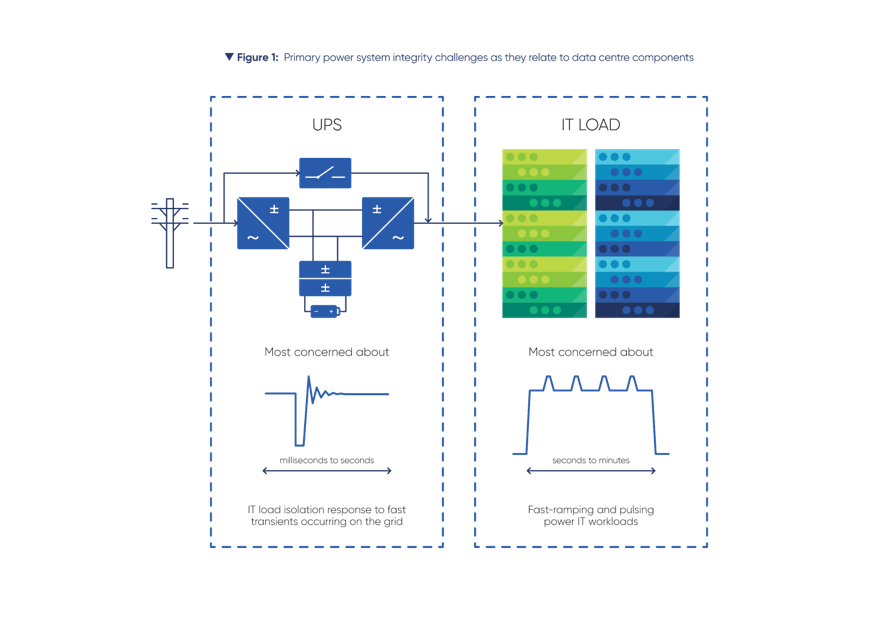
From a power system perspective, large data centres behave differently from the passive loads the Australian power system was designed for. While factories and processing plants tend to be relatively static and predictable, modern data centres are predominantly inverter‑based loads with fast‑acting controls and complex internal architectures.
At a high level, two interacting components are particularly important:
- The server (IT) load – this sets the facility’s power demand during normal operation. Computing workloads, particularly AI training, high performance computing and large scale cloud services, can change rapidly, driving fast ramp up, ramp down and pulsed demand profiles.
-
The uninterruptible power supply (UPS) – this governs whether the facility rides through a disturbance, transfers load to stored energy or on site generation and how and when that load reconnects to the grid. It therefore plays a pivotal role in either mitigating or amplifying concerns around a lack of fault ride through and recovery capability during a disturbance.
A starting point for industry discussion
This paper does not present a fixed or final position about the technical and operational implications of connecting data centres.
Instead, it is designed as a starting point to help frame practical conversations about how the electricity sector can respond as data centre development continues to accelerate.
We have identified four areas for stakeholders to work together to proactively integrate data centres, building on progress to date.
These areas have formed the basis of our data centre enablement framework, which includes seven near-term actions (0-2 year period).

.jfif?rev=9a3f041d88a948ada4b48a4dc1f6c714&hash=AE42FDEBF065EFEFE1E3D9F392511342)
.jfif?rev=b452e002fc4e44b685bb4b3d814dd5cc&hash=D6232A6A9258446228FEA753E64FB8D9)
.jfif?rev=8075d6f9e3fb4e93ad8ad08be46e5211&hash=C4A196CAC41BE62EB853A4220CFF74B3)


